

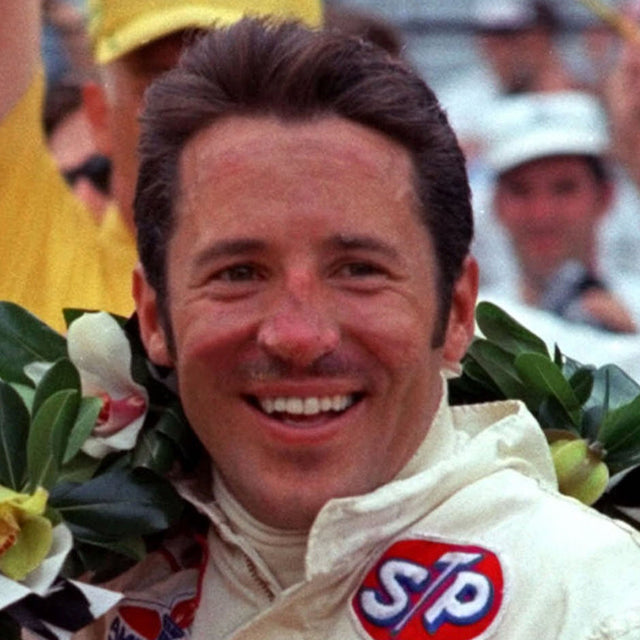
My mom is a very supportive woman. But I doubt she’s ever actually known any of the people I’ve been lucky enough to interview are—so she’s always done her best to sound “impressed” when I tell her what I’m up to at work. That was, however, until I mentioned that I’d be speaking with Mario Andretti.
“Woah,” she said. Her genuine reaction is a tiny indicator of the transcendence of Mario Andretti’s achievements. There’s scarcely a race he hasn’t entered, and only slightly fewer that he hasn’t won. He’s touched almost every discipline of the sport, bridging continents, countries, and careers with an almost righteous ease. He raced for Enzo Ferrari. Three decades later he flipped an Indycar three times in the air, “…like an F-16,” at 220 mph. Four decades before that, he was pioneering ground effect air flow technology.
Mario Andretti is a legend, and we’re incredibly excited to share our conversation with him.

Ted Gushue: What was the first car you ever drove?
Mario Andretti: I’ve meditated on this subject many, many times. I’m constantly asking myself, why cars? Why racing? What attracted me so very young to this world when my family didn’t even have a car? Maybe it’s that my family didn’t have a car . I lived the first eight years of my life in a war torn part of Italy, and then when Italy lost that territory after the Geneva Convention to Yugoslavia, we fled. The choice was to exist under hardline communism with Marshall Tito, or just leave and try to maintain our Italian citizenship and way of life.
We were refugees in our own country for 7 1/2 years, in Tuscany, in Luca. Just last week, actually, I was made an honorary citizen of Luca! We came full circle. The time that we spent there was a very dark, sad time. People who lived in the region at the time had no idea who we were or why we were there. There was almost no press coverage of the refugee situation at that time. There were maybe 1,200 of us that felt like uninvited guests, if you will.
Now all of a sudden, since 2002 Italy has recognized the refugees from the region we were originally from. I realize that this is a bit of a tangent, but I’m driving to the point of your question.
I have a twin brother, Aldo, he and I shared a nice little red bicycle when we were refugees. We would make believe that it was a gorgeous red Moto Guzzi. We would drive it around everywhere, making motorcycle noises, until we started hanging around this garage that was right across the small square from the entrance to our refugee camp. They obviously did some repairs and washing cars whatnot, and also ran a parking lot for some of the merchants who would visit the camp daily.
Now Aldo and I started befriending the two owners of the garage and they started allowing us to park the cars that would come into the camp and so, of course, Aldo and I would do burnouts. Somehow, we ended up becoming really good friends with these people. Marco Decesari and Danilo Piccinini were their names. Marco took Aldo and I to the 1954 Italian Grand Prix.

TG: The one that Fangio won when Ascari was knocked out, yes?
MA: Yes. Exactly. Aside from these events, the passion started almost out of nowhere. Now we didn’t have television obviously, there was no video coverage. We had to get all of our information on motor racing from print, which was great because of the huge involvement of Ferrari, Maserati, Lancia, Alfa Romeo and so forth.
TG: Did the Mille Miglia have any impact on you at all?
MA: Yes! In 1955, in May, a month before we came to the United States, Danilo took us to watch the race in the Abetone Pass. That’s closer to Florence.
TG: So you didn’t grow up that far apart from motorsport, it doesn’t seem too crazy that you would fall into it.
MA: Yes, but we were the ones that were showing the interest, nobody ever forced it on us. Everything that we wanted to pursue had to come from us, and luckily our friends tried to oblige us. Luckily, there were a few small local races to keep us interested, so that we could go to see something, but there was nothing like the Saturday or Sunday night races at the fairgrounds like you had here in America. None of that. The bottom line is that Aldo and I became enamored with the sport in Italy, and the mold was cast for our future when Marco took us to see the Grand Prix at Monza.
TG: What do you remember from that day?
MA: I remember being just mesmerized, overwhelmed by the sound, by the speed. We didn’t even have a grandstand seat, we were up on that bank before the Parabolica on the left. You know, we had a good view of things. It was quite a treat to be taken there, because it was it was really far from our home. The autostradas were not what they are today, etcetera.
TG: How many years passed before you got the chance to meet some of the Formula 1 drivers you saw there on that day?
MA: It took me almost 20 years, once I was racing Formula 1 in the ’70s. That’s when I first met Fangio. Obviously, I never met Ascari who was killed in 1955 during a test at Monza, testing for Sebring.

TG: What do you remember of the first time you met Fangio?
MA: I was at Donnington, he was doing an exhibition run with one of the W196 Mercedes. Of course I just had to meet him. It was very brief, but then after I had won the Argentine Grand Prix, I was invited to the opening of Fangio’s museum there, along with Stirling Moss. So he, Stirling and I stayed up talking until 3 in the morning in his studio, and they were just mesmerized with how much I knew about their careers. Most of the modern racing drivers at that time hadn’t been as well-versed in the history of these guys, and I just had so much knowledge about their careers. They were at the top during my most impressionable years. They couldn’t believe I knew so many of the particulars of their lives. It was a little bit of a mutual admiration society, as at the time I had been winning quite a lot on Formula 1.
TG: So to back up a bit, you emigrate to America in 1955 at age 15, what was your family driving at the time?
MA: The first car my Dad bought was a 1946 Ford, and about a year later he bought a ’51 Buick, and then two years later our first new car was a ’57 Chevy. That was the car that made us terrors around the neighborhood.
TG: Did you modify the Chevy?
MA: Oh, we were always doing something to that car. Glasspack muffler, you know, fuel injection. All these things my father asked, “Why are we doing this? What do these parts do?” and our excuse was always that it gave the car better gas mileage. “Dual exhausts pick up at least 4 more miles to the gallon.” My dad was not an aficionado of the sport by any means, he didn’t want to understand any of that stuff, but we did.
TG: So was that the first car you started racing?
MA: No, no that was just the car that we pretended to be the big boys with. We didn’t start racing till 1959, but we started building our first stock car which was a ’48 Hudson to run on the local track in 1957. The objective was to have the car finished for 1961, at which point we would have been legal to race at age 21. You know, professional racing with prize money. In those days you had to be 21, legally, to race in any sanctioned event because of the insurance. But we finished the car when we were 19, in 1959, so we had a local newspaper editor who was a friend of ours fudge the birthdays on our driver’s licenses. So all of a sudden we became 21.
By the time I was 23 on my license, I had a hell of a time trying to convince everyone that I was actually 21. Nobody would believe us!
TG: Was that quite common to lie about your age to get into racing back then?
MA: Probably. You didn’t have computers in those days, so you could get away with it really easily. It could have been disastrous actually. At the end of that first ’59 season, at the very last race, Aldo had a huge accident during the qualifying heat. He ended up hospitalized in a coma, and the chief of police started investigating the crash for some reason, and he came to me and asked how old Aldo was.
“Twenty-one, just like I am. He’s my twin brother.” So he demands to see my license to prove it, takes one look at it and obviously can tell that it’s fake. But he knew that if my brother was known to be under 21, the race insurance wouldn’t have covered his medical bills or the crash or anything, so he handed the license back to me and just says: “21, huh?” And then went on his way.

TG: How quickly did you move from local dirt track racing to more structured national and international competition?
MA: I started racing in ’59 and I never looked back. I spent 2 years with the cars we built, then 3/4 midgets, midgets, sprint cars, and it was just one after the other. My career progressed very naturally, always moving forward into another category. I never wanted to stay in any category longer than I had to. I wanted to get to the Indy 500 as quickly as possible. Many drivers can and did make a living and a career out of being a midget car driver. I didn’t want any of that, I wanted to go straight to Indy. To the top.
TG: During your meteoric rise, what were you driving off the track.?
MA: That ’57 Chevy.
TG: The whole time?
MA: My dad bought that car, and my brother and I had to share. It was all we needed. It got us to the track through the stock car years. We never had two of anything ’til we both got married. The early years we were earning money driving stock cars but never enough to buy a car. My first new car after I got married at 21 was a ’65 Mustang Fastback. But I had an Austin Healey and some used cars before then.
TG: What cars from that era do you still own?
MA: I don’t own any old cars. That’s one thing I’ve never had a real passion for, I just wanted to get new cars. I wanted to move forward. Always get the latest and greatest I could find. I love technology, I try to look forward constantly, not backwards. It’s very easy to look at the past and say, “Oh gosh, those were the days.” Not me, I love moving forward. Something new. Something more technical. That’s what attracted me to the sport over all of the years of my career.
TG: You’re one of the few people that we would let slide for being interested in the new stuff, partially because for you, the new stuff was at one point what we at Petrolicious are dedicated to celebrating.
MA: I fully realize that . Obviously, I’ve a very special appreciation for the opportunity to be a part of the development of motorsport technology over the years. All of the things about the construction and handling and performance of the cars that I’ve touched through my career, I’ve experienced like very few other people. Would I change the time I spent with those cars? Never, not in a million years. It’s precious. There was so much to be learned at the time that you always had so much to look forward to the next thing to be developed.
There was a period where I was involved in the tire development for Firestone, and we used to make so much progress in tire technology, sidewall construction, compounds and so forth, that from one year to the next you didn’t even need a new car, we were making huge leaps of speed just through that! Then we reached a plateau with that and we had to start working on aerodynamics, and then I was at the ground floor at ground effects! The team I was driving for started all of that. I do have an appreciation for those days because I know where we came from, and I know what we had to do to get today.

We were the first team to have its Indycar fully computerized. We were at the Ford proving grounds in Michigan developing telemetry. Moments like that are why I am always excited for the future.
TG: What did you learn or develop in Indy that you were able to translate over into Formula 1?
MA: At the time, my first Formula 1 experience was 1968, 10 years after I started racing. I took to it like a duck to water, I was successful in the beginning, on pole position in my very first race. I was at Monza, my very first test with Formula 1, set a track record. I felt very comfortable in Formula 1, and I continued to dabble in it until I did it full time in ’74.
There’s always something that transfers when you switch between styles of racing. Certain behaviors that apply. I drove dirt tracks all the way up through the ’70s, I won a national championship in Champ cars in ’74, and I had already won in F1 in South Africa in ’71. That whole time I was racing dirt.
The lack of grip on the dirt made me a much better driver in the rain. Formula 1 and Indycar both benefitted from my dirt track experience. Some of the biggest races I ever won were in the wet. The two types of racing are apples and oranges, but they’re still connected. By moving around the different disciplines it was very useful. It expanded my horizons.
My specialty has always been open-wheeled single seaters, but I was winning stock car races like Daytona. A race driver’s a race driver, but I had the opportunity to learn more because I was so curious about what the other guys were doing.
TG: Why do you think European and Formula 1 drivers don’t find a home on dirt in the way that you did?
MA: It’s all about what’s available. It’s about what’s fashionable. Is it fashionable to be a dirt track driver outside of the United States? No. I had the opportunity to do it all. There are other drivers that were successful in Formula 1 like Dan Gurney who never saw dirt though. It’s more fashionable, especially today to specialize in just one area of racing. You very rarely see an F1 driver competing in sports prototypes, like at Le Mans or wherever. It was much more common back then.
Why? I don’t know, it’s up to the individual I guess. AJ Foyt did it. Dan Gurney moved around a lot. We did it because we just loved racing, in every form I think. I was so totally passionate about it that it was all I wanted to do. One discipline alone was not satisfying me, it’s that simple. I also was very fortunate as I was able to drive for some of the top teams, which gave me the opportunity to realistically bring home some results. And that’s the ultimate satisfaction.

TG: Why do you feel that Formula 1 has never really caught on here in America? Are you happy with its current adoption by fans?
MA: Well, you have to figure that America is the only country on this planet that has elite categories and disciplines in their own motorsports. No other country really has that. Drivers here can have a very satisfying, illustrious career without really even having a passport. That’s why Formula 1, as appealing as it is, international, sophisticated in every way, you don’t have the widespread interest that say NASCAR does. It’s rather you know, more basic and derivative cars. Until the mid-’90s, Indycars were supreme here in the states. Some of that changed because of the politics around that scene, still today an Indycar driver could have a very satisfying career never leaving the sport. Very few young American talents probably had that dream of Formula 1 because they don’t feel like they need it. That’s probably why you don’t have this widespread interest in Formula 1.
Don’t underestimate it though, we still have a pretty strong fan base here. Of course our races are struggling here, but there is still a fanbase. It’s just competing with incredibly strong homegrown disciplines.
TG: And when you hear people like Bernie Ecclestone say things like he did in the press recently that essentially he wouldn’t pay his own money to go watch a Formula 1 race today, how does that make you feel?
MA:

TG: Give me the Mario Andretti interpretation of Bernie Ecclestone.
MA: I love the guy. I truly do. He always does stuff like that for a reason. He wants to wake these guys up, wants to simplify all these crazy technical rules. He’s more interested in the show aspect than say the pure technical side of it. A lot of the manufacturers who are big in F1 now they try to constantly have the pinnacle of technology, which sometimes doesn’t produce the best show, or makes it very predictable.
But I’ve known Bernie since he started in Formula 1 in ’72. He saw the potential in Formula 1. He secured the TV rights for the sport. That’s what brought the real wealth to Formula 1. I’ll tell you what, if you’ve been at it for the long haul like I have, or if your one of these teams that’s been there forever, they’ll all tell you that Formula 1 has benefited from Bernie being involved. Every other type of racing was jealous when Bernie did what he did. NASCAR was jealous. Indycar was jealous. He invented the concept of big money in motorsport. He made racing drivers some of the highest paid athletes in the world.
You’ve gotta look at the big picture, of what he’s done for the sport. That’s when you start to understand him. Does he have a love/hate relationship with the community? Sure. But if you know him intimately in the way I do, and know exactly what he’s done over the years for Formula 1, you’ll know that no other man could have done what he did. And I appreciate him for that.

TG: What’s he like in person?
MA: Very interesting individual. Straightforward. What you see is what you get. A handshake is all you need with Bernie. A solid man, no nonsense. I tell you he’s the best negotiator I’ve ever met in my entire life. He intimidates governments! That’s who he is though! He’s an amazing man. I tell you, the day that he is no longer a part of Formula 1, that is the day that Formula 1 is going to suffer. Mark my words.
TG: Who else in F1 has had a larger than life personality like Bernie that you’ve worked with?
MA: Enzo Ferrari. Colin Chapman. These are individuals that were bigger than life, then and now.
TG: What was it like to work with Enzo?
MA: Again, here was a guy that just demanded results. But he was a guy that also understood when the cars had shortcomings. He was one that could always appreciate the effort that a driver made, when you were just busting your butt, flat out, flinging the car, and all that. He was one guy that knew and saw that. He was a guy that was all-in. Had no other interest in life outside of motor racing and all of the intricacies of it. Somewhat misunderstood in many ways because he was so demanding, so tough on everyone, but at the end of the day he was correct. Always correct. And that’s why you had the respect that you had for him.
When I look back at what’s precious in my life, it’s that I was able to have a 1:1 relationship with the man. Dealt directly with him. Drove for him. Won for him. That’s one of the most valuable parts of my life.

TG: Was Enzo somewhat of a father figure for you?
MA: Father figure isn’t the right term. A father figure is one that understands and sympathizes. He was one that could be very intimidating. He was more like a school principal. Wouldn’t tolerate it if you were jacking around. You’d do just about anything to get a smile out of his face. If he really, really approved of what you were doing you got a light smile out of him. That was just huge when that happened.
TG: Tell me about Colin Chapman.
MA: Colin had the reputation he had because he wanted to give the driver every possible advantage, and he knew that weight was the issue. He was adamant about weight. Many times it crossed over and it cost the drivers, and I knew that. But I was not shy about making certain demands, I had an incredibly good relationship with his mechanics. Like Bob Dance.
I said to Bob, if you see anything in your own mind that Colin is trying to do that is just a little too radical, or a little too over the limit, please let me know. I told him I like to be reasonable, so I felt like I had a security blanket in that area away from some of Colin’s more out-there ideas. But I was always looking at Colin, there was a confidence aspect that he was doing everything possible to get you a winning car. He was a maverick for sure, but that’s what drove him. He was never one to sit on his laurels, he would get bored with the status quo.
He was very creative, very moody. You had to be with him at just the right time, which I was, because he had peaks and valleys in his own career because he was always trying to play outside the box, which sometimes didn’t work because he was too radical. But when he was right on, he was right on. And I enjoyed that part of it obviously, and took advantage of that by bringing home a world championship for Lotus.

TG: When you were driving for Lotus, or other marques in general, were there ever cars that scared you?
MA: No, if I had felt that I would have expressed that. I came from position of strength as far as being a driver, I never had to worry about getting fired, within reason, and of course I didn’t want to get hurt. The spectrum of failure was always there, but if something looked unreasonable I would just say no.
For instance, all of a sudden when we switched to titanium pedals, clutch throttle and brake. And I just said no. I insisted on a steel brake. The tensile strength of titanium under panic breaking just isn’t enough. I forced the switch back to steel. Titanium brake pedals are what almost killed Clay Regazonni at Long Beach in 1980. The brake pedal broke, and the crash paralyzed him for life.
There was another one where they wanted to do titanium rocker arms on the suspension and I flat out said no. I had some say in areas when I believed something could be catastrophic when it broke, but I always had confidence in the engineers that I was driving for.
TG: Were there any crashes in your career that stand out as particularly memorable?
MA: I did several flips at Indy in 2003 at testing. There was a piece of safe wall on the track after Kenny Bräck crashed in front of me. Right in the middle of the track I hit the safe wall. I was doing my son a favor by helping him test the car, subbing in for Tony Kannan. I’d been out of Indycar for nine years, and they had me sub in for Tony. Right at the end of the day I was trying to get a big tow from Kenny right in front of me, and his engine exploded going into a turn. There was a chunk of the safe barrels that they’d just installed that flew into the middle of the road. I ran over it. That “unstuck” the car.

I was coming out of turn 1 doing about 222 mph, according to the telemetry. That’s when the car turned into an F-16, and I did three backflips about 28 feet in the air. But somehow landed on the wheels, which was obviously a blessing.
TG: What was the worst car you ever drove?
MA: That’s easy: The car is an old Can-Am car, and it was called a Honker. Designed by Len Terry, it was a Ford Project in 1967, and I determined that was the worst race car I ever drove.
TG: What was the best car you’ve ever driven?
MA: Any car I could win a race in.
TG: How would you compare today’s racing drivers with the same racing drivers that you grew up with?
MA: Quite honestly, I believe that the champions of yesteryear would be champions of today, and vice versa. I think it takes a very special person to compete at that level in any decade. The job of the driver is to wring 101% out of the car the individual has been given. It takes a lot of commitment, passion and burning desire to be able to be a champion or a winner. You had to have that today, and you had to have it then.
TG: What’s the fastest speeding ticket you’ve ever gotten?
MA: I actually don’t really get tickets. I’ve been really really lucky, but I never drive recklessly. If I’m driving fast, I never put anyone in any danger. Never cut anyone off, etcetera. I’ve been stopped a few times, but let’s just say they’ve always been kind to me. I always try to behave, though.

Photos Courtesy of Mario Andretti


